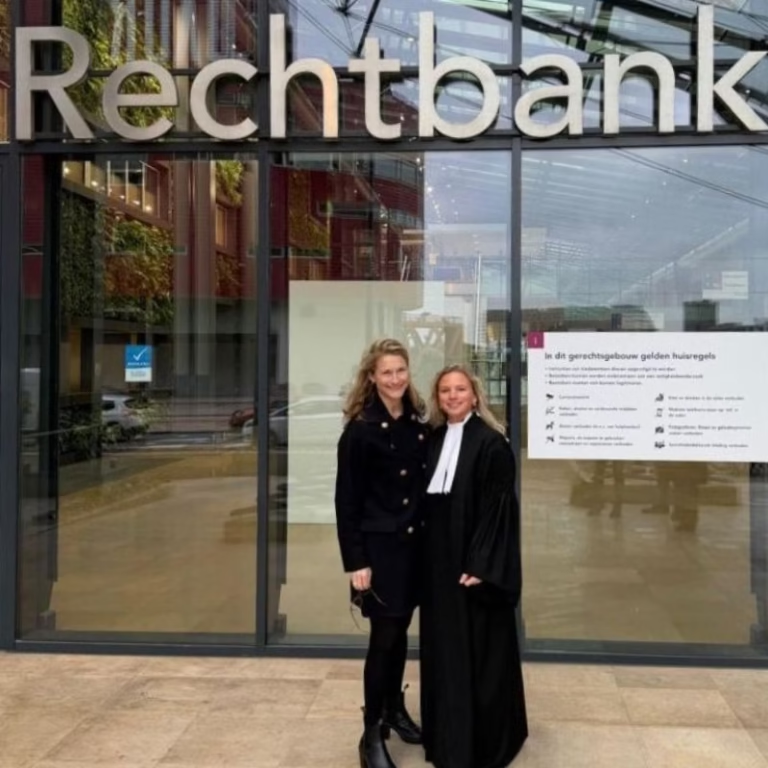
The Hague District Court, 30 April 2026, ECLI:NL:RBDHA:2026:9555
Facts
The employee started working for Jumbo as a checkout assistant on 11 November 2025 under a zero-hours contract. The employment contract included a probationary period of two months. The Food Retail Sector CLA (CAO Levensmiddelenbedrijf) applied to the contract.
On 13 November 2025, at the start of her first shift, the employee told her supervisor that she had discovered the evening before that she was pregnant. A few weeks later, on 27 November 2025, she reported sick via WhatsApp due to severe nausea. She indicated she was unable to come to work and asked whether she needed to call in sick by phone or whether the WhatsApp message was sufficient.
The supervisor responded that he “was done with it”, as he could not rely on her. By letter dated 30 November 2025, Jumbo confirmed that the employment contract had been terminated with immediate effect during the probationary period.
The employee argued that this constituted an invalid probationary dismissal and pregnancy discrimination. She asked the subdistrict court, among other things, to award fair compensation and damages.
Ruling
The subdistrict court first ruled that a valid probationary clause existed. Under Dutch law, a probationary period of at most one month may be agreed for an employment contract of longer than six months but shorter than two years. The CLA, however, provided for a probationary period of two months. Because the CLA had been declared applicable through an incorporation clause, it was, in principle, permitted to deviate from the statutory rule.
Nevertheless, the subdistrict court ultimately applied a probationary period of one month. The CLA also stated that statutory provisions more favourable to the employee remained in force. According to the subdistrict court, this did not mean the probationary clause was entirely void, but that the probationary period was reduced to the statutory duration of one month. Because Jumbo had given notice within that month, the dismissal was, in principle, valid.
The subdistrict court then assessed whether the probationary dismissal was discriminatory. An employer may not give notice during the probationary period because of pregnancy or an illness related to pregnancy either. According to the subdistrict court, the employee had put forward sufficient facts to raise a presumption of discrimination. After all, she had reported being pregnant shortly after starting work and was dismissed immediately after reporting sick due to nausea.
It was therefore up to Jumbo to prove that the dismissal was unrelated to the pregnancy. Jumbo succeeded in doing so. Jumbo argued that the employee was dismissed because of her attitude, conduct, and performance. According to Jumbo, she regularly arrived late, did not fit well within the team, and colleagues had raised concerns about her attitude. Jumbo substantiated this with, among other things, an overview of scheduled and clocked-in times, which showed that the employee had clocked in late on six of the ten days she worked, twice by a significant margin.
It was also relevant that the supervisor had already, before the sick leave, indicated he wanted to speak with the employee about her conduct regarding swapping a shift. According to the subdistrict court, the sick leave the following morning was, for Jumbo, the “final straw”, but not the reason for the dismissal. The subdistrict court considered it sufficiently proven that the dismissal was related to the employee’s attitude and performance, not her pregnancy.
The employee’s request was therefore refused. There was no discriminatory probationary dismissal. Nor was there an irregular termination or seriously culpable conduct by Jumbo.
What does this mean for employers?
This ruling confirms that an employer has considerable freedom to terminate an employment contract with immediate effect during the probationary period. No reasonable ground is required, and the prohibition on dismissal during illness does not apply during the probationary period either.
That freedom is not unlimited, however. A probationary dismissal must not conflict with the prohibition on discrimination. This means an employer may not give notice because of pregnancy or a pregnancy-related illness. Where the timing of a dismissal raises a presumption of discrimination, for example because notice is given shortly after a pregnancy announcement or pregnancy-related sick leave, the employer must be able to show that the dismissal had a different reason.
This ruling shows that a probationary dismissal shortly after a pregnancy announcement is not automatically discriminatory. In such a case, however, the employer must be able to clearly explain and substantiate that the dismissal was based on other, non-discriminatory grounds.
Do you have questions about probationary dismissal or workplace discrimination? Please feel free to contact one of our employment lawyers.
Click here for the full ruling (in Dutch).